 English
 Italiano
 Español
 Francais


Marco Scaglione
My professional biography and my story are linked together they kept strong by a strap which is called passion. I'm lucky: I like my job, I enjoy it and it fills me with satisfaction.
It was born a new collaboration between Marco Scaglione and Aksum. Click on the logo and visit their site.
Crispy loaf with chickpea flour
Full list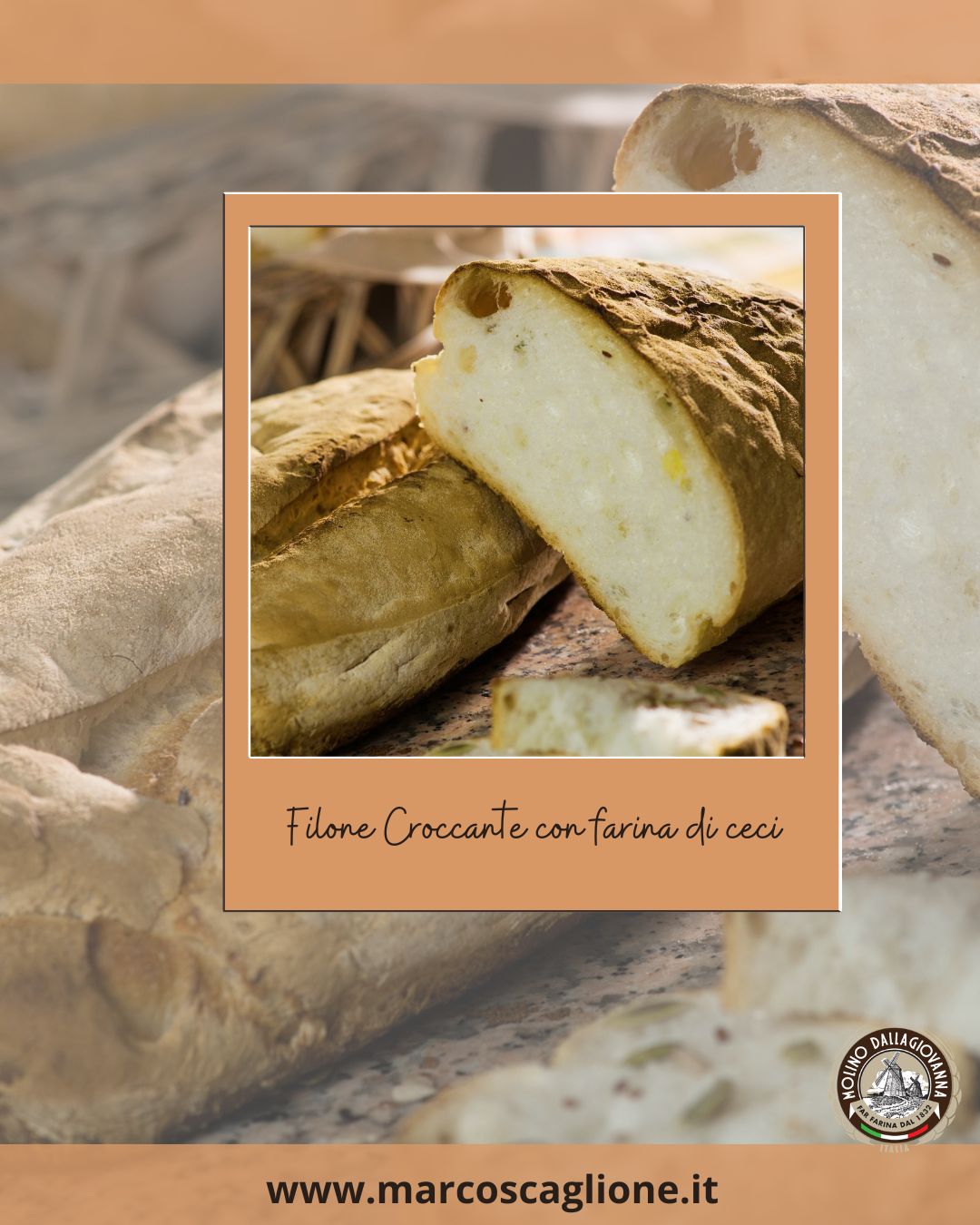
 Condividi su:



Time: 20 minuti più riposo
Difficulty: facile
Characteristics:
Chickpea flour is produced by finely grinding the dried seeds of *Cicer arietinum*, although the varieties used are generally not the same as those intended for consumption as whole chickpeas.
Chickpea flour is widely used in Liguria to make *farinata*, a local specialty.
Historical background:
The earliest archaeological evidence of *Cicer arietinum* comes from Iraq and dates back to the Bronze Age (3500–1200 BC). Subsequently, chickpea cultivation spread to Egypt and the Roman Empire.
Notes:
The chickpea plant is highly drought-resistant.
It is cultivated in both temperate climates and semi-arid environments; sowing takes place in mid-winter. The plant does not tolerate compacted soil or soil with excessive moisture or waterlogging; it requires good levels of phosphorus but less nitrogen.
Ingredients for 1.040 kg of dough:
450 g Molino dalla Giovanna "Speciale Pane e Pizza" (Bread & Pizza Mix)
50 g extra-fine gluten-free chickpea flour
18 g fresh yeast
20 g acacia honey
350 g water
80 g extra virgin olive oil
15 g fine salt
Gluten-free rice and corn flour for dusting
Dough preparation method:
Place the mix and the chickpea flour in a mixing bowl or a stand mixer fitted with the paddle attachment, and mix briefly at low speed.
Dissolve the yeast in a separate bowl with the water and add it to the flours; mix everything together thoroughly and very slowly. Add the honey and continue kneading until it is fully incorporated.
Finish by adding the oil and salt; knead for another 2 minutes. Then, remove the dough from the mixer bowl using a spatula or plastic dough scraper and shape it into a ball, using a little rice and corn flour to help.
Shaping
Divide the dough into two parts and shape them into loaves on a floured surface.
Brush each loaf with an emulsion of equal parts water and oil.
Proofing and Baking
Place the loaves on a baking sheet lined with parchment paper and let them rise for about 1 hour at room temperature (there is no need to cover them with plastic wrap or a cloth).
Preheat the oven to 220°C. Once the oven reaches temperature, bake the loaves for about 30 minutes at 220°C. When they are crispy and golden brown, remove them from the oven and let them cool at room temperature for at least 20 minutes before slicing.